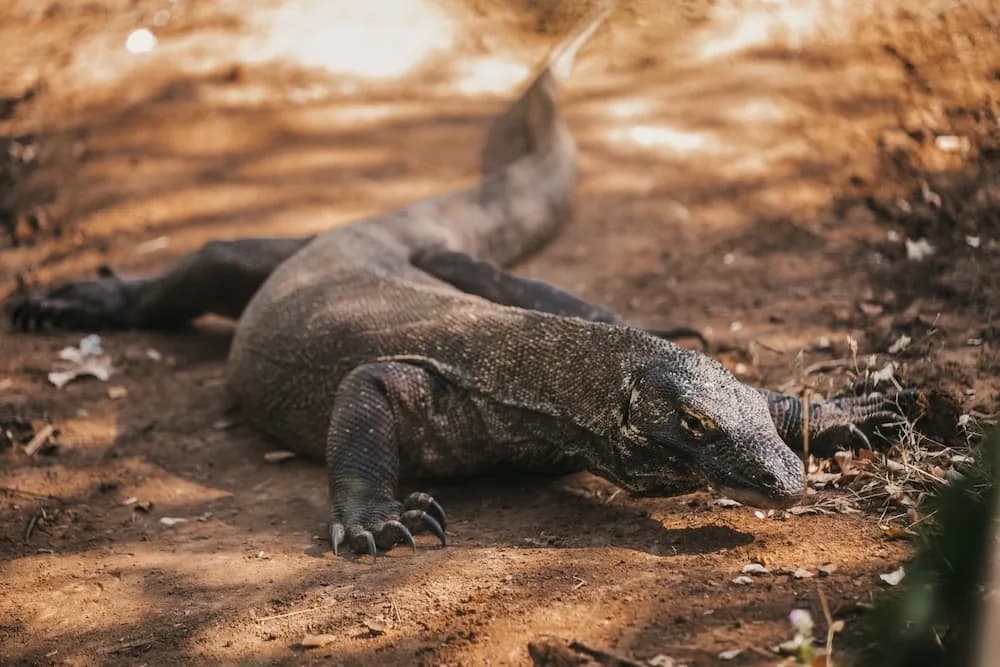
The Komodo dragon (Varanus komodoensis) is the largest living lizard on Earth, and in the wild you'll find it on only a handful of islands in East Nusa Tenggara, Indonesia. Males grow to roughly 3 metres and 150 kilograms, carry a genuinely venomous bite, and are now listed as Endangered. Here's what the animal is actually like, where it lives, and how to see one without getting it wrong.
What a Komodo dragon looks like
You'll know one on sight from its size alone. An adult male averages about 2.59 metres and the largest approach 3 metres, weighing up to around 150 kilograms. The body is covered in tough, beaded scales, the legs are heavily muscled with long claws, and the tail is strong enough to prop the animal upright.
Its most distinctive feature is a forked, yellowish tongue, which it uses to taste prey on the air from a long way off. On the islands it calls home, the Komodo dragon sits at the top of the food chain.
hewan endemik ntt
- Status (Komodo (Varanus komodoensis))
- Terancam Punah (Endangered, IUCN)sumber
Updated June 2026
komodo
- Behavior (gigitan)
- punya kelenjar bisa di rahang bawah yang menurunkan tekanan darah dan mencegah pembekuan darah; gigitan = luka mekanis + venom. Mitos 'air liur penuh bakteri mematikan' sebagian besar terbantahsumber
- Classification
- kadal terbesar di dunia yang masih hidup, nama ilmiahnya Varanus komodoensissumber
- Length (jantan, maksimum)
- 3 msumber
- Range
- endemik di Indonesia: Pulau Komodo, Rinca, Gili Motang, Gili Loh Sami, dan pesisir barat serta utara Floressumber
- Status
- berstatus Terancam Punah (Endangered) di IUCN Red Listsumber
- Weight (jantan, maksimum)
- 150 kgsumber
Updated June 2026
What Komodo dragons eat and how they hunt
As the apex predator, an adult Komodo dragon preys on the large hoofed animals that share its islands, chiefly deer, wild pigs, and buffalo. It was once thought to be mainly a scavenger, but newer research shows it's also an active hunter that stalks prey patiently before ambushing at close range. In a single meal it can swallow an enormous amount of meat, and it will still make use of a rotting carcass. Young dragons have a different menu: because they're small, they hunt insects, eggs, birds, and little lizards.
Why young Komodo dragons live in trees
One of the most striking facts about the Komodo dragon is how its young survive. As soon as they hatch, juveniles climb and spend their first few years up in the trees. The reason is sobering: adult dragons are cannibals that readily eat smaller ones, and young dragons are thought to make up part of an adult's diet. Living in the trees keeps the young safe from that threat until they're big enough to come down and live on the ground.
The bite: venom, not a "dirty mouth"
For years the Komodo dragon was thought to kill with deadly bacteria in its saliva. Bryan Fry and his team overturned that in 2009: the animal has venom glands in its lower jaw, producing toxins that drop blood pressure and stop blood from clotting, so prey weakens and keeps bleeding.
So the bite works two ways at once: a ragged wound from serrated teeth and a powerful pull, plus that venom. The dirty-mouth idea no longer holds, since the bacteria in a Komodo dragon's mouth are no nastier than in other carnivores. A few researchers still debate whether bacteria play a minor part, but the main driver is clearly the venom.
Reproduction and the wonder of parthenogenesis
A female lays around twenty eggs, which incubate for several months before hatching. But what makes the Komodo dragon truly remarkable is that it can reproduce without a male, through a process called parthenogenesis. In certain conditions, such as when no male is around, a female can still produce eggs that hatch, and strikingly, every offspring born this way is male. This rare ability is thought to help the species survive and spread to new islands even when mates are scarce.
How long Komodo dragons live
The Komodo dragon is a long-lived animal. It takes roughly eight to eleven years to reach maturity and, in the wild, is estimated to live up to around thirty years. That slow growth, combined with limited numbers, makes every individual valuable to the survival of the species.
Where Komodo dragons live
The Komodo dragon is endemic, meaning it lives in just one place on Earth. You'll find it on Komodo, Rinca, Gili Motang and Nusa Kode (known locally as Gili Loh Sami), plus parts of the west and north coasts of Flores. The largest population is protected inside Komodo National Park, a conservation area that's also a UNESCO World Heritage Site.
Conservation status
Since 2021 the Komodo dragon has been listed as Endangered on the IUCN Red List, up from its previous Vulnerable status. The wild population is estimated at around three thousand individuals, fairly stable on the larger islands like Komodo and Rinca but declining on the smaller ones as prey grows scarce. Its range has also narrowed under human pressure, and its coastal habitat is expected to come under more strain from climate change. That's why seeing one almost always happens inside a protected area, under a ranger's watch, rather than on your own.
Seeing them in the wild
The usual way is a trip into Komodo National Park from Labuan Bajo, the main gateway to the Komodo islands. Inside the park a ranger who understands the animal's behaviour goes with you, and trekking on your own is not allowed. The rules are simple but serious: keep your distance, no sudden movements, and follow the ranger. A Komodo dragon looks calm when still, but it's a fast runner and very much a wild predator. One more thing worth flagging: if you're menstruating, let your ranger know, so they can stay especially alert on the trek.

Komodo Day Trip: Padar, Pink Beach & Dragons in 1 Day
komodo · 1 Day · 4.8
Experience Padar Island, Pink Beach, Komodo dragons, snorkeling, and Kalong Island—all in one unforgettable day from Labuan Bajo
from
$142 USD
To plan the wider trip, from which islands to visit to the best season and how to get there, start with our Komodo destination guide.
FAQ
What is a Komodo dragon?
The Komodo dragon (Varanus komodoensis) is the world's largest living lizard, found wild only in East Nusa Tenggara, Indonesia. Locals around Flores also call it ora.
What are the main features of a Komodo dragon?
It's the largest living lizard: males average 2.59 metres (up to nearly 3 metres) and weigh as much as 150 kilograms, with tough scaled skin, long claws, a powerful tail, and a forked yellow tongue for tracking prey by scent.
Is a Komodo dragon's bite dangerous to humans?
Yes. The bite tears the wound open and delivers venom that stops blood from clotting, so bleeding is hard to control. That's why you must keep your distance and stay with a ranger inside the national park.
Where can I see Komodo dragons in the wild?
In Komodo National Park, mainly on Komodo and Rinca islands, reached by trip from Labuan Bajo. This is the only place the animal can be seen in the wild, safely and with a ranger.
How big is a Komodo dragon?
Adult males average about 2.59 metres, with the largest near 3 metres and weighing up to roughly 150 kilograms. Females are usually a little smaller.
What do Komodo dragons eat?
Adults prey on large animals like deer, wild pigs, and buffalo, both by ambushing live prey and by scavenging carcasses. Small juveniles eat insects, eggs, birds, and little lizards.
Can Komodo dragons reproduce without a male?
Yes. Through a process called parthenogenesis, a female can produce eggs that hatch without being fertilised by a male, and every offspring born this way is male.