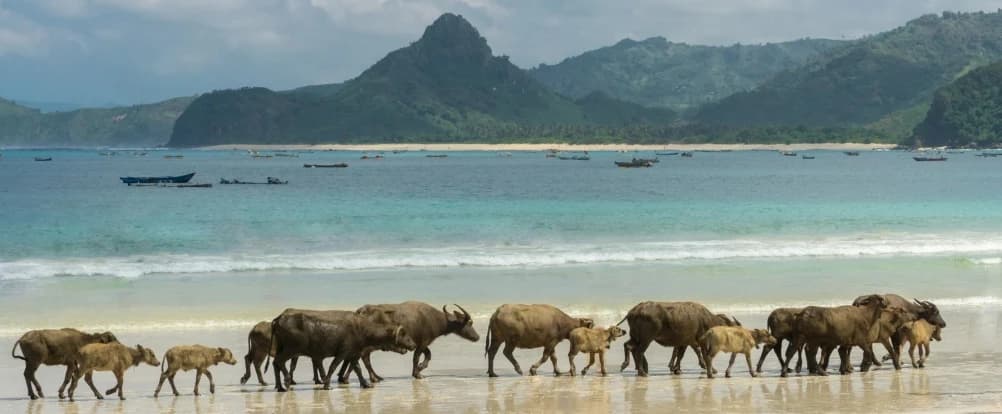
7 Days in Lombok — Classic Route
Seven days in Lombok, classic route—paced for first-timers but with enough off-script room to feel like yours. This itinerary threads Lombok's three beating hearts: the volcanic north (Mount Rinjani, rice terraces, local warmth), the island-hop clarity of the Gilis, and the raw coast where surf meets sand. Skip the guidebook pace. You'll arrive calm, leave changed.
jakartalombok~2.5 hours direct
IDR 800K–1800Kbalilombok~30 minutes direct
IDR 400K–900Kkuala-lumpurlombok~3.5 hours direct
IDR 1500K–3000KDay 1 — Arrival & Senggigi warmup
At a glance
- Getting there: Fly to Lombok International Airport (LOP) from Bali, Jakarta, or Kuala Lumpur. Fast boats run daily from Bali to the Gili Islands.
- Best time: May through September is the dry season with clear skies for trekking and calm seas for island hopping.
- Transport: flight from bali (~30 minutes direct, IDR 400,000–900,000)
Fly into Lombok International Airport (LOP)—30 minutes from Bali if you're island-hopping, 2.5 hours from Jakarta, 3.5 hours from Kuala Lumpur. Expect IDR 400,000–900,000 from Bali, IDR 800,000–1,800,000 from Jakarta. Ground transport to Senggigi takes 45–60 minutes by road (around IDR 150,000–250,000 for a private car or ojek).
Check into your guesthouse by early afternoon. Senggigi's beachfront sprawls north for 5km—lined with warung, dive shops, and that particular blend of tourist infrastructure and local rhythm that makes it feel lived-in rather than staged. Swim at the main beach if the current's gentle (check with your guesthouse staff—they read the water daily). Late afternoon, walk to Batu Bolong temple, perched on a rocky outcrop 15 minutes north on foot—the viewpoint catches sunset amber and the temple's peaceful enough that you'll understand why locals come here to pray, not just tourists to photograph.
Dinner: head inland one street from the beachfront strip. A warung called Warung Sunset (look for the painted wooden sign) serves grilled fish, gado-gado, and sambal that doesn't pull punches—around IDR 80,000–120,000 per person. Eat on plastic stools. Listen to the motorbikes and gamelan from a nearby wedding. Sleep in Senggigi tonight.
Day 2 — Rinjani orientation & foothills
Drive inland toward Mount Rinjani (1.5 hours from Senggigi, ~60km). You're not summiting today—that's Day 3–4. Today you're acclimatizing, exploring the foothills, and meeting your trekking crew if you've booked a guide.
Stop at Tetebatu village (45 minutes off the main road, worth the detour). Rice terraces cascade down green slopes—this is where Lombok's inland beauty lives, far from the beach-resort circuit. Walk through the fields for an hour if the light's good (early morning or 4pm onward, before the heat peaks). Local farmers still use water buffalo and hand tools. A guesthouse called Rinjani View has a small café overlooking the terraces—drink fresh lime juice, eat banana pancakes, watch the rhythm of agricultural life you've left behind.
Return to a midrange guesthouse in Senaru village (the base town for Rinjani trekking, 2–3 hours from Senggigi). Senaru sits at 600m elevation—you'll feel the cooler air by evening. Wander the village market in late afternoon (vendors pack up by 6pm). Eat at a family warung near your guesthouse. Many serve nasi kuning, chicken soup, and fresh vegetables at IDR 40,000–70,000 per meal. Sleep in Senaru. Rest your legs.
Day 3–4 — Mount Rinjani summit trek (2–3 days compressed into 2)
This is the centerpiece—Indonesia's second-highest volcano, 3,726m, with a crater lake and panoramic viewpoints that justify the pre-dawn starts and burning thighs.

3-day Mount Rinjani Trekking via Sembalun Route
lombok · 3D2N
Summit Indonesia's second-highest volcano (3,726m), Mt. Rinjani, with overnight camps at the crater rim and lakeside hot springs. Segara Anak crater lake and Gunung Baru mini volcano inside make this one of Southeast Asia's greatest treks.
from
$129 USD
Most operators run 2–3 day treks from Senaru. A standard 2-day sprint climbs from Senaru (600m) to the crater rim (2,639m) on Day 1, then pushes to the summit (3,726m) at dawn on Day 2, and descends by afternoon. It's steep, it's relentless, and your lungs will remind you that you live at sea level.
Day 3 morning: Depart Senaru at 7am with a guide and porter (most operators pair you with a guide who knows the water sources and the safest footing). The trail climbs 2,000m elevation gain over 8–10 hours. You'll pass through cloud forest where the air cools and the light goes soft. Porters will set up camp around 2,000m—bring a headlamp, warm layers, and expect a simple dinner (rice, vegetables, perhaps an egg) cooked on camp stove. Sleep at altitude. You won't sleep deeply, but you'll sleep.
Day 4 before dawn: Wake at 2am. Headlamp-lit climb to the crater rim takes 2–3 hours. The rim summit is your payoff—you can see clear to Flores on clear mornings, and the crater lake (Segara Anak) sits 500m below like something from a dream. Stay 90 minutes watching the light change. Then—if your legs cooperate and the guides say the weather's holding—a smaller group climbs the final scramble to the true summit (3,726m) for an hour of true isolation. Descend back to camp by 10am. Rest. Eat. Descend the trail in afternoon (another 4–5 hours downhill, harder on the knees than the ascent).
You'll be sore. Your feet will blister. You'll question every choice. You'll also remember this for the rest of your life.
By evening, you're back in Senaru. Shower. Eat something substantial. Sleep 12 hours if you can.
Day 5 — Senaru to the Gili Islands
Drive west to Bangsal harbor (1.5 hours from Senaru, 50km). Bangsal is a working harbor, not a tourist resort—you'll see fishing boats, working nets, and the actual logistics of island life. This is intentional. You're not bypassing infrastructure.
Fast boats run hourly from Bangsal to the three Gili Islands (Meno, Trawangan, Air). The crossing takes 15–30 minutes depending on which island and which boat operator. Boats cost IDR 50,000–100,000 per person. The ride is wet if the swell's up—bring a waterproof bag for your phone.
Island choice:
-
Gili Trawangan is the social hub—restaurants, dive shops, nightlife centered on the beachfront strip. It's crowded (peak season can feel like you're sharing an island with thousands), but it's also where you'll find the easiest logistics and the widest food range.
-
Gili Air sits between Trawangan and Meno—quieter than Trawangan, more social than Meno, with good snorkeling immediately off the beach.
-
Gili Meno is the silent one—few restaurants, minimal nightlife, and the reef system is pristine because fewer people paddle out. Choose Meno if you want to read, swim in near-solitude, and interact with a tight community of expats and locals who chose quiet deliberately.
Pick Gili Air for balance. You'll have restaurants, dive options, and snorkel access without feeling like you're in a resort queue.
Check into a guesthouse on the eastern shore (the calmest water, best for swimming). Expect IDR 250,000–500,000 per night for a clean double with fan and porch. Swim at sunset. Eat fresh fish grilled to order at a beachfront warung (IDR 120,000–180,000 per plate). The water around the Gilis is warm enough that you'll sleep with your window open listening to waves.
Day 6 — Gili snorkel & reef immersion
Rent a snorkel set from your guesthouse (IDR 50,000–100,000 per day) and wade into the shallow reef immediately off the beach. You don't need a boat tour—the house reef is alive with parrotfish, snappers, wrasses, and if you're patient, turtles. The reef sits 20–50 meters offshore, depending on tide.
If you want to go deeper or visit multiple sites, hire a longtail boat and guide for the day (IDR 400,000–800,000 for 4–5 hours, split between your group). Guides will take you to Shark Point (where you might see blacktips, though they're shy), Japanese Garden (coral gardens dense with small fish), and Turtle Beach on Gili Meno (where turtles graze the shallow seagrass beds—absolutely surreal to float above them).
Bring reef-safe sunscreen. Drink plenty of water. The sun on the water is relentless.
Afternoon: rest. Swim. Read under a palm. This is the pace-reset day.
Dinner: find a small warung run by a Sasak family (your guesthouse can point you)—they'll serve nasi goreng made with local chilies, grilled squid, and sambal matah that tastes like the island itself. IDR 70,000–110,000 per person.
Day 7 — Gili to Kuta Lombok & departure option
Fast boat back to Bangsal (15–30 minutes, IDR 50,000–100,000). Drive south to Kuta Lombok (1.5 hours, 50km). Kuta Lombok is NOT a resort town—it's a fishing village with long, clean beaches, powerful surf breaks, and the kind of quiet you only get when tourists haven't yet colonized the infrastructure.
If your flight departs in the evening from Lombok International (LOP), Kuta gives you a final 4–5 hours. Swim (the beach is safe for wading in the morning, rougher by afternoon). Eat at a warung on the beach—grilled fish, rice, iced tea, IDR 60,000–100,000. Watch surfers if the swell's up (May–September brings consistent groundswell from the Indian Ocean, with breaks like Gerupuk and Selong Belanak drawing experienced surfers).
If your flight is the next morning, stay overnight. A guesthouse in Kuta runs IDR 200,000–400,000 for a clean room. Sleep listening to waves. Depart for the airport in the morning (45 minutes, 35km, IDR 150,000–250,000 by private car).
Practical logistics
Visas: US, EU, Australian, and Canadian citizens get 30-day tourist visas on arrival (IDR 500,000 at the airport).
Flights: Book flights 2–3 weeks ahead to lock reasonable fares. May through September (dry season) books earlier; January–April is cheaper and quieter, though rain can shorten visibility on mountain days.
Money: Lombok uses Indonesian Rupiah (IDR). ATMs line the main streets in Senggigi and on Gili Trawangan. Small warungs and guesthouses may not accept cards—keep cash for village meals and boat fares.
SIM card: Buy a local SIM (Telkomsel or Indosat) at the airport or at any convenience store. IDR 100,000–200,000 gets you a month of data and calls. Useful for messaging guides and calling ojek drivers.
Trekking prep: If you're summiting Rinjani, arrive in Lombok 1–2 days early to acclimatize. Bring proper hiking boots (not trail shoes), warm layers for the summit night (it drops to 5–10°C at 3,700m), and a headlamp. Porters carry most gear, but your daypack should hold water, snacks, and sun protection.
Water: Drink bottled water only. Guesthouses provide free refills from coolers. Tap water isn't safe for tourists.
Tweak the order to your interest—manta encounters follow seasonal currents (more likely July–September), Rinjani summits reward early starts and clear skies (April–October), and reef colors pop in calm mornings before the afternoon chop. Whatever rhythm you choose, Lombok reveals itself to travelers who move slow enough to notice—the terraced green, the turtles under glass water, the Sasak families grilling fish at dusk.