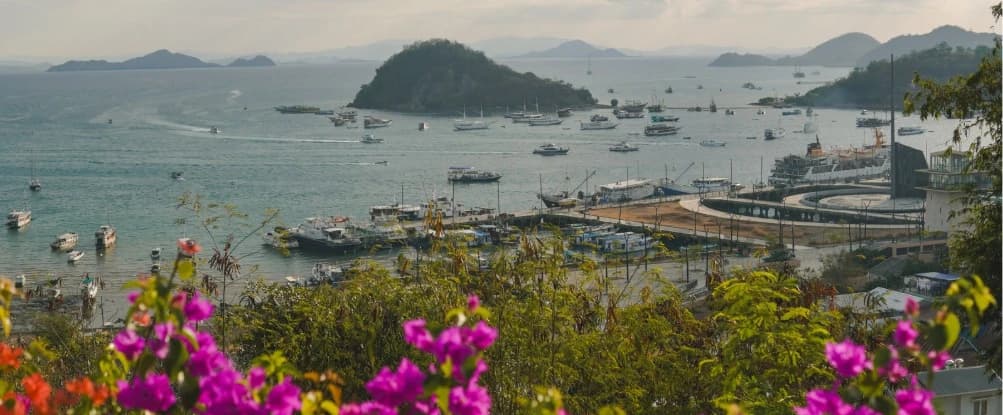
"Planning your first trip to Labuan Bajo? Here are 10 things we'd actually do and why each one shapes how you experience this corner of Indonesia. These aren't ranked by Instagram count; they're ordered by how they fit into a real itinerary, what season suits them best, and how they layer into each other. Start here and build your own route."
jakartalabuan-bajo~3.5-4 hours connecting
IDR 1200K–2800Kbalilabuan-bajo~1.5 hours direct
IDR 700K–1600Ksurabayalabuan-bajo~2-3 hours direct/connecting
IDR 900K–2000K1. Trek with rangers to see Komodo dragons on Rinca Island
At a glance
- Getting there: Fly to Labuan Bajo (LBJ) from Bali (1.5 hours), Jakarta, or Surabaya. Most visitors connect through Bali, it is the quickest and most scenic gateway to Komodo.
- Best time: April to June and September to November offer the calmest seas and best diving visibility. The dry season means clear skies for island hopping and reliable manta ray encounters.
- Transport: flight from bali (~1.5 hours direct, IDR 700,000–1,600,000)
This is the anchor. You're not visiting Labuan Bajo to skip the dragons, they've lived here for millions of years, and a guided ranger trek is the only responsible way to encounter them. Rinca Island is closer to Labuan Bajo than Komodo Island proper (about 1.5 hours by boat), making it the practical choice for day trips or liveaboard stops.
Book a ranger trek—they're mandatory, and they're worth every rupiah. Rangers read track, behavior, and seasonal patterns; they know which watering holes concentrate dragons in dry season (April–October) and where juveniles hunt in monsoon. A short loop takes 45 minutes to 1.5 hours depending on what you want to see. Wear closed shoes, bring a wide-brimmed hat, and don't underestimate the heat, the landscape is sparse, exposed, and stunning in that austere way.
Rinca also holds Komodo's sister creatures: wild boar, water buffalo, enormous monitor lizards that aren't quite dragons. The ranger will show you the difference. Whatever you do, don't approach animals solo the ranger fee (~Rp 80k per group) is non-negotiable protection and expertise combined.
2. Snorkel the pink sand and coral gardens at Pink Beach
Pink Beach exists because of crushed red coral and volcanic minerals rare enough to be worth seeing, and the snorkeling just offshore is genuinely good. Schools of fusiliers, parrotfish in full color, occasional turtles, and sea cucumbers that look like they belong in a different ocean.
The beach itself is cramped if you go midday on a liveaboard route dozens of boats unload snorkelers between 10am and 1pm. The trick is timing: if you're on a day trip, leave before 8am. If you're on a liveaboard, anchor overnight or hit it at dawn. The water's usually calm enough in dry season (April–October), but even in shoulder months (November, March) it's manageable if you're a confident snorkeler.
Bring reef-safe sunscreen, a rash guard if you burn easily, and a dry bag for cameras. The sand is fragile reef safe isn't a suggestion, it's respect. Most tours bundle Pink Beach into a 1- or 2-day Komodo route; standalone day trips cost around Rp 500k–800k per person from Labuan Bajo.
3. Dive or snorkel at Manta Point when conditions align
Manta rays are seasonal and unpredictable they follow currents and food, not itineraries. Dry season (April–June, September–November) brings more consistent encounters because upwelling currents funnel plankton, and mantas follow the food. But even in "good" months, conditions matter: you need favorable current direction, decent visibility, and luck.
If you're diving (open water or higher cert required), Manta Point rewards early starts and patience. If you're snorkeling, the same applies but understand you're in the water with a creature with a 2-meter wingspan, relying on your guide's read of behavior. Dive outfits from Labuan Bajo know the conditions daily; ask before booking. A single manta dive or snorkel costs Rp 100k–150k fuel/guide on top of tour fees.
Don't go expecting guaranteed mantas. Go expecting world-class underwater topography, cleaner fish stations, and the possibility of mantas. When they show, it's unforgettable but the magic is in the conditional.
4. Sunrise at Padar Island's ridgeline viewpoint
Padar Island has no dragons, no sandy beaches worth camping on, but it has one of Indonesia's most sculpted viewpoints: a ridgeline that drops into turquoise bays on three sides. The trek up takes 30–45 minutes of steep, exposed scrambling wear proper shoes and start before dawn.
You're aiming for first light—the sky turns pink, the valleys fill with shadow, and the three bays below shift from black to emerald to turquoise in about 20 minutes. It's crowded (the liveaboard fleets anchor near Padar), but that rush of people doesn't diminish the view; it just means you finish sunrise and head down while others are still arriving.
Bring water, sun protection, and realistic expectations about your own fitness it's scrambled hiking, not a walk. Most 2–4 day liveaboards include Padar; day trips from Labuan Bajo can add it for around Rp 80k fuel per person.
5. Explore Rangko Cave's freshwater pools and limestone chambers
Rangko Cave is inland you need transport from Labuan Bajo town (about 2 hours by car) or, more practically, a full-day guided excursion that bundles it with other north-coast stops. Inside, you'll find freshwater pools fed by underground springs, stalactites, and a cathedral-like main chamber where sunlight filters through cracks.
It's less famous than Komodo's marine sites, which means fewer crowds and more quiet. Bring a headlamp, wear sandals that can handle wet rocks, and don't expect luxury amenities the cave is raw and functional. A guide is helpful for navigating the pools safely and knowing which chambers are passable.
Half-day Rangko trips (including transport and guide) run Rp 300k–500k per person from Labuan Bajo town. It pairs well with other land-based stops if you're building a multi-day trip that mixes Komodo and cultural exploration.
6. Watch sunset from Bukit Cinta (Love Hill) overlooking Labuan Bajo harbor
This is the easiest on the list—a 15-minute drive from Labuan Bajo town up a short, paved hill overlook. Bukit Cinta offers a 180-degree panorama of the harbor, islands, and sunset arc. It's popular with locals and travelers; you'll find informal warung setups selling drinks and snacks.
Go late afternoon, bring a light jacket (it's breezy at height), and expect to share the view. The actual "love" part is a concrete heart sculpture; the real draw is the hour-long soft-light show as the sun sets over the Flores Sea. If you're staying in Labuan Bajo town, it's a natural evening wind-down after boat days.
Entry is free; warung prices are standard (kelapa muda, ~Rp 15k; nasi padang plates, Rp 25k–35k). Most hotels can arrange transport for Rp 50k–100k round-trip.
7. Night snorkel or drift dive to see nocturnal reef behavior
This is specialized and requires a liveaboard or committed day-trip operator. After sunset, the reef transforms—octopi hunt, lobsters emerge, and bioluminescence flickers in the water column. A night snorkel with a powerful torch is eerie and meditative; a night dive is a full sensory reordering.
Night snorkeling is safer and more accessible than night diving (no certification required, guide-dependent). Most liveaboards offer it as an optional add. Day-trip operators don't usually run nights, so you're looking at a 2+ day tour if this is on your list.
Best in calm conditions and dark-moon phases (minimal surface light interference). Visibility can be poor, but that's part of the draw the torch becomes your whole world, and the reef responds to light like a living organism.
8. Sail the Flores Sea aboard a traditional kapal pinisi (wooden sailing boat)
A kapal pinisi is an Indonesian-built wooden sailing boat some are working fishing vessels, others are passenger liveaboards, but all have that distinctive two-mast rig and teak hulls. Sailing one through Labuan Bajo's waters is less about destination and more about the vessel itself.
You can do this as a day trip (full-day sailing from Labuan Bajo harbor, ~Rp 400k–700k per person) or commit to a 2–4 day liveaboard that makes the sailing part of the route. The difference is rhythm: a day sail gets you moving, but a liveaboard builds time to sit on deck at dawn, watch the sails catch wind at noon, and feel the boat settle at anchor.
Most commercial kapal pinisi tours include snorkel stops and meals; some operate seasonally (dry season is peak). The sailing itself is the point—the physical sensation of wind and teak, the slow pace, the sense of going somewhere the way travelers did 50 years ago.
9. Visit Padar's sister viewpoint at Kelor Island (Bat Island) cliffside
Kelor Island (also called Bat Island) sits a short boat ride from Padar and offers a similar sculptural view point sheer cliffs dropping into turquoise water, with a bat colony living in the cave system above. The trek is shorter and less crowded than Padar (15–20 minutes upslope), and the view trades Padar's three-bay panorama for a more intimate cliff-and-water composition.
Timing matters: early morning (before the afternoon cruise crowds) or late afternoon (when boat traffic thins) are your windows. Many liveaboards skip it in favor of Padar alone, which makes Kelor a quiet alternative if you're planning a day trip or flexible itinerary.
The bats are most active at dusk, if you're at Kelor in late afternoon, you may see the colony pour out of the cave. A boat fee (~Rp 50k) sometimes applies; check with your operator.
10. Bargain for fresh fish at Labuan Bajo's harbor market early morning
This is hyper local and requires zero logistics just show up at the harbor around 6–7am when fishing boats unload the night's catch. You'll find marlin, grouper, snapper, calamari, and reef fish still glistening. Prices are raw (no middleman markup), and if you stay in a villa with a kitchen or rent a space with cooking access, buying here and hiring a cook for dinner is cheaper and better than restaurant meals.
Bring cash (Indonesian rupiah small vendors may not have change for large bills), go early, and don't haggle hard on live or fresh-unloaded fish; the margins are already thin. This is also where you observe how Labuan Bajo actually works fishing supplies, ice, fuel, gossip, and real commerce happening before tourists wake up.
Whatever draws you to Labuan Bajo dragons, reefs, or quiet harbor dawns these 10 experiences form the backbone of why people come here. Most fit naturally into a 3–4 day liveaboard or a series of day trips; some require specific seasons or conditions. When your dates firm up, the tours on this page handle the logistics booking boats, coordinating rangers, timing tides. Your job is deciding which moments matter most to you.

Sailing Slow, Chasing Sunsets: 6-Hour Classic Wooden Boat Escape
labuan-bajo · 1 Day
Leave the rush behind and step aboard our classic wooden boat for a 6-hour afternoon escape. Drift through the Komodo archipelago at a relaxed pace, perfectly balancing vibrant ocean exploration with the breathtaking natural spectacle of Kalong Island at twilight.
from
$32 USD