"Planning your Lombok trip?" Here are 10 things we'd actually do — and why each one earns its place on the island beyond the Bali comparisons.
At a glance
- Getting there: Fly to Lombok International Airport (LOP) from Bali, Jakarta, or Kuala Lumpur. Fast boats run daily from Bali to the Gili Islands.
- Best time: May through September is the dry season with clear skies for trekking and calm seas for island hopping.
- Transport: flight from bali (~30 minutes direct, IDR 400,000–900,000)
Lombok doesn't need a qualifier. It has an active volcano you can summit, surf breaks that work year-round, an archipelago of three distinct islands just offshore, and a Sasak culture that's been weaving, building, and cooking here for centuries. The ten things below aren't filler — they're the experiences that make this island what it is.
1. Trek to the summit of Mount Rinjani
Lombok's defining experience. At 3,726 metres, Rinjani is Indonesia's second-highest volcano — and the crater lake, Segara Anak, sitting at 2,000 metres with a young cone rising from its centre, is one of the most dramatic landscapes in Southeast Asia. The standard summit route runs 3 days / 2 nights from Senaru or Sembalun. Expect 7–9 hours of hiking on summit night alone, starting around midnight to catch sunrise above the cloud layer. Dry season (May–September) gives the most reliable trail conditions and clearest summit views. Our 3-day Rinjani trek handles simaksi, gear, and a certified guide — the permit system tightened in recent years and registration via TNGR (Taman Nasional Gunung Rinjani) is mandatory.
2. Island-hop the Gili Islands with a plan
Gili Trawangan, Gili Meno, Gili Air — three islands with three different personalities, all reachable by fast boat from Bangsal harbour (30–45 minutes) or direct speedboat from Bali. Trawangan is the social one: beach bars, dive schools, snorkel trips by bicycle-circled streets with no motorised vehicles. Meno is quieter, with a turtle sanctuary at the northwest point and the famous underwater sculpture garden — a cluster of human figures submerged in ~3–5 metres, photographable on a single breath-hold. Air sits closest to the Lombok coast and has a real village feel alongside the dive operations. Dry months (May–September) keep the snorkel visibility sharp — 15–20 metres on a good day. Budget a full day per island minimum; one-day multi-hop circuits feel rushed.
3. Surf Kuta Lombok's breaks (not Kuta Bali)
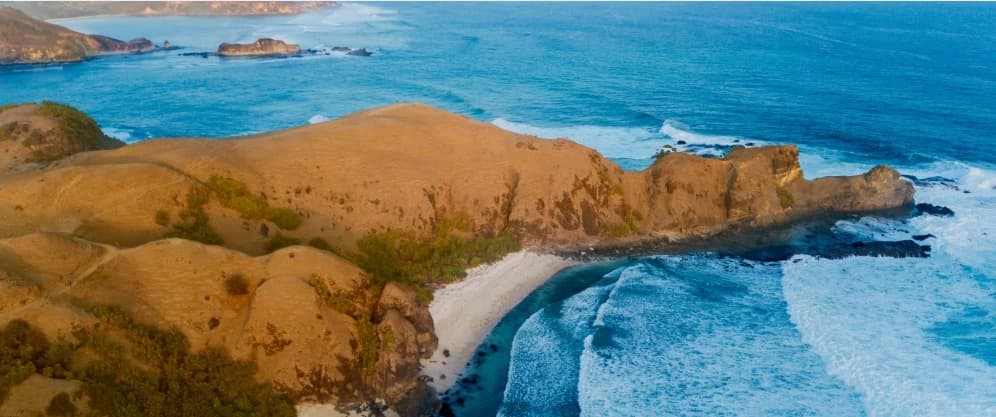
The name overlap causes confusion — Kuta Lombok is a separate town, 65 km south of Mataram, with a completely different character. The beaches here curve into crescent bays with white sand and turquoise water; the surf breaks draw a mix of intermediate and advanced surfers. Selong Belanak, 15 km west, offers gentler waves better suited to beginners. Gerupuk Bay, 7 km east, has multiple peaks across a sheltered bay — boat access to the outer breaks costs around Rp 50–75k per session. Peak swell runs April–October, though the bay breaks work most of the year. The warung strip along Kuta Lombok's main beach is low-key and local — cold kelapa muda, fresh grilled fish, no cover charges.
4. Wake up early for the Sembalun Valley
Most visitors drive through Sembalun as a Rinjani trailhead. That undersells it. The valley sits at ~1,100 metres on Rinjani's eastern flank, ringed by ridgelines, with strawberry and tobacco farms on the valley floor. The early-morning light — roughly 5:30–7:00am — hits the fields and mist in a way that stops most people in their tracks. If you're not trekking, the valley is worth a half-day drive from Mataram (~2–2.5 hours via the northern coast road). Combine with a stop at Pura Batu Bolong or the Sembalun viewpoint before crowds arrive.
5. Spend a morning in a Sasak village
Lombok's cultural heart belongs to the Sasak people — the island's indigenous majority, with a distinct language, weaving tradition, and architectural style. Sade village, 8 km from Kuta Lombok, is the most-visited: 150+ residents, traditional rice-barn architecture (lumbung), and hand-woven songket textiles sold direct. Entry is by voluntary donation; expect Rp 20–50k as the norm. Sukarara, about 25 km north, specialises in weaving demonstrations — you can watch ikat and songket being made on traditional backstrap looms. The craft isn't performative; women here weave as livelihood, not tourism show. Buy direct from the weaver if you want something, and ask which pattern before purchasing.
6. Chase the sunrise from Bukit Merese
A short hike (20–25 minutes) from Kuta Lombok town leads to the Merese hilltop — open grassland, unobstructed 270-degree views over Tanjung Aan bay and the south coast. Sunrise from here puts you above the morning cloud over the bays before the tour groups arrive. Come between 5:00–6:30am and you'll often have the ridge to yourself. No entry fee. No facilities. Bring your own water and leave nothing behind — the grass is fragile and the path shows wear.
7. Snorkel the Gili Islands' turtle cleaning stations
While Gili Meno's sculpture garden gets the attention, the turtle cleaning stations around all three Gili Islands — particularly the coral heads off Gili Trawangan's northwest corner and Gili Air's east side — offer reliable sea turtle sightings in 3–8 metres of water. Turtles come to reef fish to remove parasites; they tend to linger at specific coral heads repeatedly. Rent a mask and fins from any beachfront operator (Rp 30–50k/day) and free-snorkel independently, or join a half-day guided snorkel that covers three or four sites across the islands (~Rp 150–200k per person). Water visibility peaks May–September.
8. Take the Labuan Bajo–Lombok sailing route
If you're connecting Komodo and Lombok — or building a larger Nusa Tenggara journey — the sailing route between Labuan Bajo and Lombok gives you three to four days at sea on a traditional wooden vessel. You'll pass through Sumbawa, stop at lesser-visited bays, and arrive in Lombok from the sea rather than the airport. Our 4-day sailing trip runs this route with a crew that knows where to anchor away from crowds. It's not a fast connection — it's an experience in itself. Plan around May–September for the calmest crossing; the Lombok Strait has strong tidal currents and open-ocean swells outside dry season.
9. Eat through Mataram's pasar malam
Mataram, Lombok's capital, gets skipped by most itineraries that head straight south to Kuta or north to Senaru. That's a mistake if you care about eating. The evening markets (pasar malam) around Cakranegara and Ampenan run from around 5:00pm, with sate pusut (spiced minced meat satay on lemongrass skewers), ayam taliwang (Lombok's fire-grilled chicken with chilli paste), and plecing kangkung (water spinach with sambal terasi). Street-food prices: Rp 15–30k per dish. The fish market at Ampenan, active from around 5:30am, runs an entirely different register — buy direct and take to a nearby warung for cooking. It's the kind of morning that earns the rest of the day.
10. Catch a performance of Presean stick fighting
Presean is Sasak traditional martial art — two fighters (pepadu) spar with rattan sticks (penjalin) and buffalo-hide shields (ende) in a ritual combat that's part sport, part ceremonial offering to invoke rain. Public performances happen most frequently during the Lombok Culture Festival (July–August) and Lebaran celebrations, but smaller demonstrations occur at cultural venues in Mataram and Sade village throughout the year — ask your accommodation or local guide for timing. It's not a tourist show invented for visitors; presean has been practised here for centuries and the crowd involvement — calling encouragement, circling close — makes it unlike anything else on the island.
Lombok has more depth than any one trip catches. Pair these with our curated Lombok tours when your dates firm up — or read our practical first-timer's guide before you book.