"Planning your Ambon trip? These are the most essential things to understand before you go — from why the Moluccas matter to divers and historians alike, to which seasons reward which interests, to how the islands actually connect."
Ambon sits at a crossroads that few destinations can claim: it's where three centuries of spice-trade history meets some of Indonesia's most biodiverse coral reefs, where colonial fort ruins stand near thriving Muslim communities, and where the rhythm of island life hasn't accelerated much since the last trading ship sailed. For travelers, that means you're not choosing between history or diving — you're stepping into a place where both are woven into the landscape, the food, the stories locals tell, and the way the light hits the water at dawn.
The Moluccas earned their nickname — the Spice Islands — because cloves, nutmeg, and mace grew nowhere else on Earth. For centuries, that botanical accident made Ambon contested territory: Portuguese, Dutch, British, and Japanese powers all fought to control the trade. Those conflicts left visible marks — the 16th-century Dutch fortress at Benteng Belgica, the Japanese tunnels, the scattered graveyards — and invisible marks too, in the way islanders speak about their own history with mixture of pride and pragmatism. Understanding that context changes how you read the place.
Why Ambon, and When to Come
Ambon's appeal splits into two clear camps: reefs and research (May–September), and history and warmth (April–June, September–November).
The dry season — May through September — flips Ambon into a diver's destination. The Banda Sea, which wraps the Banda Islands to the south (a 90-minute ferry from Ambon city), calms down. Currents become predictable. Visibility climbs to 25–40 meters on good days. You'll see schooling tuna, passing sharks, walls of soft coral, and the kind of macro life — nudibranchs, mantis shrimp, octopus — that makes macro photographers forget to surface. The water temperature hovers around 28–29°C year-round, so a 3mm wetsuit is enough. If diving is your primary reason, book May through July.
If you're drawn to history, colonial architecture, and the slower rhythm of island life, April–June and September–November offer the best balance: warm days, occasional rain (which cools the afternoon), and fewer liveaboard groups competing for reefs. The wet season (December–March) brings heavy downpours, rougher seas between islands, and occasional tour cancellations — avoid unless you're committed to off-season solitude and have flexible dates.
How to Structure Your Time
Most visitors arrive in Ambon city — Kota Ambon — either by air (via Pattimura International Airport, about 30km south) or ferry from Makassar or Jakarta. The city itself warrants 1–2 days: the fort, the museum, the waterfront warung culture. But Ambon's real depth unfolds when you venture south to the Banda Islands or east to islands like Seram and Ora.
A 4–5 day rhythm looks like this:
- Days 1–2: Ambon city — Benteng Belgica, the Museum Siwalima (Rp 50k entry, worth 2 hours), the old Dutch cemetery, waterfront neighborhoods where lunch is fresh grilled fish at a warung for Rp 50–80k.
- Day 3: Day trip or overnight to Seram's eastern shore — Ora Beach or Pasir Putih. These aren't Instagram-famous, which means the reef is healthy and the beaches quiet. Boat ride 1.5–2 hours from Ambon city.
- Days 4–5: Banda Islands dive trip, either day-trip speedboat (tiring but possible) or ideally a 3–4 day liveaboard. This is where the Moluccas' underwater reputation is earned.
Alternatively, if you have 7–10 days and diving is central, a full liveaboard through the Banda Sea — staying on a kapal pinisi or live-aboard dive boat for the entire time — means less logistical friction and more reef time.

Banda Sea Diving Liveaboard
ambon · 7D6N
Premium diving liveaboard through the Banda Sea — one of the last frontier dive destinations on Earth. Hammerhead schools, pristine walls, and volcanic seamounts. For experienced divers seeking the extraordinary.
from
$2,839 USD
The Islands: What Each One Offers
Ambon City and Ambon Island — the administrative and historical hub. Benteng Belgica (Dutch: 1575) sits on a rocky outcrop overlooking the harbor; bring climbing shoes and water, as the paths are steep and shaded. The fortress itself is less intact than Benteng Oranje in Ternate, but the harbor views and the sense of colonial layering — Dutch, Japanese occupation, modern Indonesia — make it worth the morning. The Museum Siwalima, just inland, holds the largest collection of Moluccan ethnographic material in the region: traditional clothing, nautical instruments, historical documents. Entry is ~Rp 50k. Lunch should happen at a waterfront warung where fishermen land their catch at dawn — order the snapper (kakap) or grouper (kerapu) grilled whole, with sambal matah (raw chili sauce) and steamed rice, for Rp 60–100k.
Seram Island — the largest of the Moluccas, lightly visited, with mangrove-fringed coasts and interior rainforest home to birds-of-paradise. Most visitors touch only the eastern shore: Ora Beach (a 1.5-hour boat ride from Ambon city, cost ~Rp 500–700k for a small speedboat split with others) is a crescent of fine sand backed by dense palms. The reef is strong — fish biomass here exceeds some of the Banda Islands — and utterly uncrowded. Stay overnight at one of two guesthouses (basic, Rp 250–400k/night including meals), snorkel the morning and afternoon, and return to Ambon the next day refreshed. If you're inland-curious, Manusela National Park (gazetted 1986) protects the interior: a trek to Wahai village takes 2–3 days and requires hiring a local guide (Rp 800k–1.2M for the group). That's specialist-traveler territory, but the biodiversity payoff — cuscus, cockatoos, rare frogs — is real.

Ora Beach & Seram Island
ambon · 3D2N
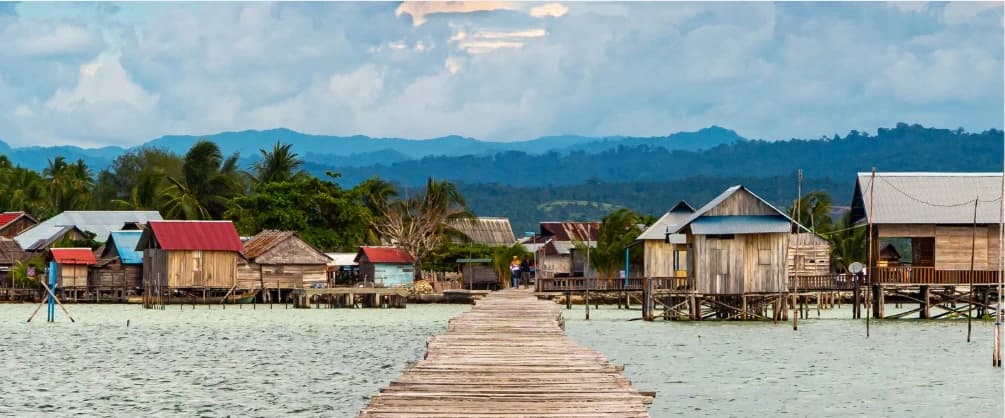
Overwater bungalows at Ora Beach on Seram Island — crystal-clear water, house reef snorkeling from your balcony, and the rainforest-covered mountains of Seram behind you. One of eastern Indonesia's most magical stays.
from
$242 USD
Banda Islands — Banda Neira, Run, Ai, and Gunung Api form an archipelago 140km south of Ambon, reached by a 90-minute ferry from Ambon city (Rp 300–400k one-way) or a 45-minute speedboat charter (Rp 2–3M for a small group). Historically, these islands were the source of pala — nutmeg — and the Dutch East India Company's (VOC) most prized possession. The nutmeg plantations are still there, terraced on Banda Neira's slopes. The walls of Benteng Belgica (yes, another one — the Dutch built multiple) still stand. The colonial cemetery holds graves from the 1600s. But for divers, the Banda Islands' true value is the reefs: the waters around Gunung Api (an active volcano) and the western side of Run are among Indonesia's healthiest coral systems. Currents here can be strong — 1–2 knots is normal, 3+ knots is possible — so diving is intermediate-to-advanced. Species density is extraordinary: chromis, snappers, groupers, tunas, sharks, and if the currents align, pelagic action on open-water dives.
Most visitors spend 3–4 days here: a mix of guided snorkel/dive days and a day exploring the historical sites on foot.

Banda Neira 4D3N Private Trip
ambon · 4D3N
Four days on the islands Europe once fought over: Banda, where nutmeg first grew. The trip leaves from Tulehu harbour, five hours across by fast boat. The first afternoon goes to Banda Besar — Fort Hollandia, the old nutmeg groves, Sumur Pusaka, and Lonthoir jetty. Day two belongs to the sea: dolphins on the way to Hatta Island, snorkelling there and off Syahrir, then Karaka or the old lava flow if time allows. Day three is deliberately slow — the morning is left open, the afternoon walks Neira itself: Fort Belgica, Nassau, the Mini Palace, the old church, and Hatta's house of exile. Three nights in air-conditioned rooms, every meal, land and sea transport, entrance tickets, a guide, plus photo and drone coverage are included. The Ambon–Banda fast boat ticket is bought separately, as is snorkelling gear.
from
$226 USD

Banda Neira Historical & Diving Trip
ambon · 4D3N
Explore the Spice Islands where nutmeg reshaped global trade routes. Dive pristine walls around Pulau Hatta, walk colonial forts on Banda Neira, and snorkel volcanic reefs. History and marine life in equal measure.
from
$226 USD
Diving: Reefs, Seasons, and What to Expect
If you came for the diving, here's the honest assessment: Ambon and the Banda Islands offer very good reefs, not "once in a lifetime" reefs. The difference matters.
The Banda Islands' top dive sites — Pulau Ay, Gunung Api's slopes, the channels around Run — deliver consistent 20–35m visibility, healthy hard and soft coral, strong fish populations, and genuinely rare macro life (hairy squat lobster, ghost pipefish, bobtail squid). You're unlikely to see a mola or a whale shark here; the water isn't as clear or prey-dense as Socorro or the northern Red Sea. But you will see reefs that feel alive and aren't hammered by tour groups. That's increasingly rare.
Dive operators in the Banda Islands run day trips from Banda Neira (Rp 1.2–1.8M per day including 2 dives, gear rental Rp 250–400k) or multi-day liveaboard trips aboard traditional kapal pinisi or modern catamaran hulls. Liveaboards run 3–7 days, with prices from Rp 20–30M (roughly $1,300–1,950 per person in a shared cabin) to Rp 50M+ for luxury boats with fewer guests. In the dry season (May–September), liveaboards run regularly; booking 2–4 weeks ahead is standard.
A practical note on dive logistics: If you're a casual snorkeler (not a certified diver), don't feel pressured into certification here. The reefs off Seram and even Banda Neira reveal themselves beautifully from 4–8 meters of water, where the light is best and the snorkel-accessible fish life is robust. A 3-hour guided snorkel with a local operator (Rp 400–600k including lunch) often yields more joy than a rushed certification course.
Logistics: Flights, Ferries, and Timing
Getting there: Pattimura International Airport (AMQ) connects to Jakarta (3.5 hours), Makassar (1 hour), and Manado (2 hours) via Garuda, Lion Air, and Batik Air. Domestic flights typically run Rp 1.2–2M depending on advance booking. Ferries from Makassar (Rp 300–500k, 14–16 hours) or Jakarta (Rp 500k–1.5M, 24–36 hours) exist but are slow; fly unless you're committed to the ferry experience.
Getting between islands: Small speedboats (5–8 passengers) run daily from Ambon city to Seram (Rp 500–700k, 1.5 hours) and to Banda Neira (Rp 800k–1.2M, 90 minutes). Organized ferry services exist but run irregularly; private speedboat charters are more reliable (Rp 2.5–4M for a boat, split 4–6 ways). If you're doing a liveaboard, the boat handles all inter-island movement.
Accommodation: In Ambon city, mid-range options (Beta Maluku Hotel, Natsepa Ambon) run Rp 400–700k/night. In Banda Neira, small guesthouses (Gidi Homestay, Merdeka Cottage) are Rp 350–600k/night and often include meals. On a liveaboard, cabins range from Rp 2.5M–5M per person per night depending on boat size and cabin type.
The Seasons, Really Spelled Out
May–September (dry season): Predictable weather, calm seas, best visibility. Ideal for diving. You'll share reefs with other tour groups, especially in July–August. Expect morning departures (5:30–6am) to maximize dive time.
April, June, October–November (shoulder): Rain is lighter, occasional downpours in afternoon. Seas are calmer than wet season but less predictable than dry. Fewer crowds. If you're flexible on dates, these months reward patience — you often get better reef conditions with a fraction of the visitors.
December–March (wet season): Heavy downpours, stronger currents, occasional rough boat crossings. Some operators reduce schedules or pause liveaboards. Unless you're specifically seeking solitude and have flexible dates, avoid. Water temperature stays around 28–29°C, so it's not cold; it's the logistics that suffer.
What to Pack (and What Not To)
- Reef-safe sunscreen: Ambon's equatorial sun is intense. Use SPF 50+, reef-safe (zinc oxide or avobenzone base — no oxybenzone or octinoxate, which bleach coral).
- Closed-toe shoes: The volcanic islands have sharp rock everywhere. Reef shoes or lightweight hiking boots prevent cuts.
- Underwater camera or GoPro: The reefs deserve documentation, and the macro life will reward a close lens.
- Seasickness medication: If you're prone to motion, bring it. Speedboat rides to Banda Neira can be bouncy in shoulder-season swells.
- Modest clothing for island villages: The Moluccas are predominantly Muslim. Loose shirts and knee-length shorts/skirts show respect, especially on Banda Neira where the community is tight-knit.
- Don't pack: Heavy luggage (flights are small-plane regional hops with luggage restrictions; Pattimura allows 20kg checked + 7kg carry-on), or expectations of high-speed internet (it exists but isn't reliable outside Ambon city).
A Final Note on Arriving with Questions
The Moluccas' appeal isn't manufactured. It's real — the reefs are healthy, the history is layered and human-scaled, the islands are quieter than Bali or Komodo, and the logistics are manageable if you plan ahead. What you won't find here is a package deal that solves everything: Ambon requires a bit of intentionality, flexibility on boat schedules, and comfort with moving between small islands. That friction is also the source of its charm. Local guides in Banda Neira or Seram know their reefs intimately and have time to linger. Colonial forts haven't been reconstructed into tourist spectacles. The warung will serve you the fish that arrived that morning.
When your dates firm up, the dive liveaboards and multi-day trips on this page handle the complex logistics. Everything else — arriving with curiosity about why these islands mattered, and patience for how they still do — you bring yourself.