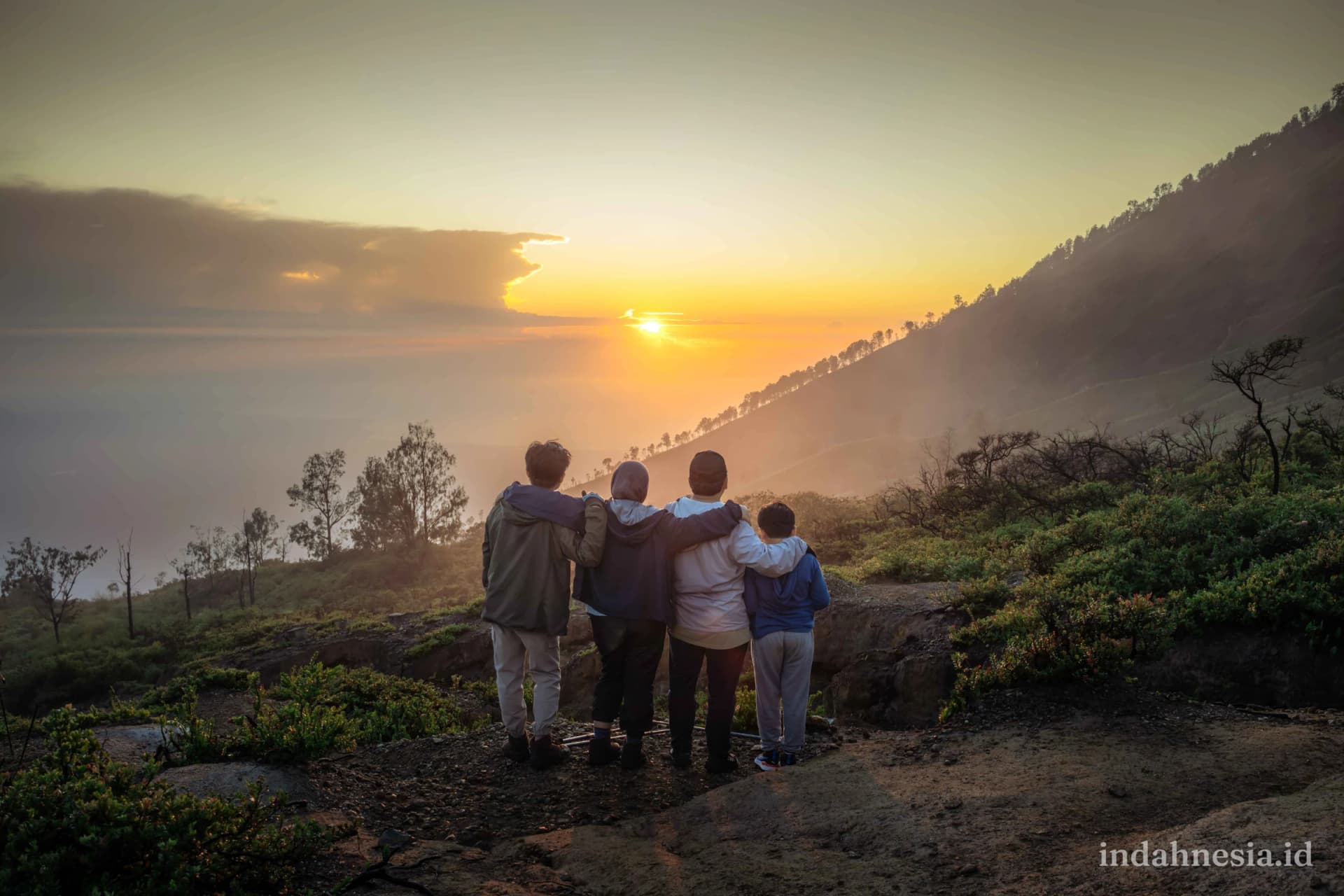
Banyuwangi sits at the eastern tip of Java, facing Bali across a narrow strait, and it holds three very different landscapes within a few hours of each other: a volcanic crater lake with blue flames at night, a savanna that looks like East Africa, and a southern forest peninsula with a world-class surf break. Most visitors only see Ijen. This guide shows how to fit all three into a sensible trip.
Opening hours, entry rules and trail conditions change. Ijen in particular can be closed or restricted when volcanic gas levels are high. Confirm current conditions with your operator before you travel.
The three areas at a glance
| Area | Best time | Minimum time | Difficulty | Highlight |
|---|---|---|---|---|
| Ijen Crater | Dry season, roughly April to October | 1 night plus a morning to recover | Moderate to demanding; midnight start, steep climb | Blue fire before dawn, turquoise acid lake at sunrise |
| Baluran National Park | Dry season, roughly April to October, when the savanna is open and animals gather | 1 day | Easy; mostly vehicle and short walks | Bekol savanna, banteng and deer, Bama beach |
| Alas Purwo National Park | Dry season for access and surf, roughly April to October | 1 to 2 days | Easy to moderate; long drive and rough tracks | Forest and beaches, Sadengan grassland, G-Land surf break |
Ijen Crater: blue fire and the turquoise lake
Ijen is a working sulfur volcano. The blue fire is burning sulfuric gas that glows electric blue in the dark as it escapes from the crater wall. It is best seen in the hours before dawn, and then the sunrise reveals the acidic turquoise lake below.
What to expect
- Pickup from your Banyuwangi hotel late at night, usually around 23:00 to midnight, then a drive of about an hour and a half to the Paltuding trailhead.
- The climb starts around 01:00 and takes about two hours to the crater rim. The path is steep and dusty at the start and eases toward the top.
- A descent into the crater to see the flames is optional and demanding. The ground is uneven and the gas can be thick.
- After sunrise you walk back down to Paltuding and return to town in the morning.
Health and safety
- The hike starts at midnight and needs real fitness. The altitude is not extreme, but the combination of a steep path, cold and no sleep is tiring.
- A gas mask is essential near the crater. Respirators are often available to rent at the trailhead, but bring your own if you have breathing sensitivity.
- If you have asthma, heart conditions or other respiratory or cardiac issues, speak to a doctor before attempting the climb. It is fine to stop at the rim.
- Dress in layers, wear closed shoes with good grip and carry a headlamp.
- Follow the guides and rangers. The crater can be closed on short notice for safety.
Read more on the Ijen Crater page.
Baluran National Park: the savanna of Java
Baluran is often nicknamed "Africa van Java" for its open grassland around the Bekol area. The park is dry and exposed, and in the dry season herds of banteng (wild cattle), deer and sometimes monkeys and peacocks gather near what water remains.
What to see
- Bekol savanna: the heart of the park, best in the early morning or late afternoon light.
- Bama beach: a quiet stretch of coast at the park edge with mangrove and monkeys.
- Evergreen forest section: shaded relief on the way in.
Practical notes
- The park gate is north of Banyuwangi town, roughly an hour's drive.
- Roads inside the park are rough in places and a local jeep or a high-clearance vehicle makes the day easier.
- Bring water, a hat and sun protection. There is little shade on the savanna.
- Keep a respectful distance from the animals.
See the Baluran National Park page.
Alas Purwo National Park: forest, beaches and G-Land
Alas Purwo is on the southern tip of the peninsula, and it feels remote. Its name is often translated as "the first forest". The area mixes lowland forest, grasslands and quiet beaches.
What to see
- Sadengan grassland: an open area where deer and banteng graze at the forest edge.
- Beaches: quiet coastline and forest stops, some with local spiritual significance.
- G-Land (Plengkung): a long, powerful left-hand wave that draws experienced surfers, mainly in the dry season. It is a serious break, not a learner spot.
Practical notes
- Reaching the south from Banyuwangi town takes a few hours, and the last stretch can be rough.
- G-Land is typically accessed by boat or track and runs on a camp system. Arrange access and accommodation in advance.
- Surfing here is for experienced surfers. Visitors who do not surf can still enjoy the forest and beaches on a day trip.
3 days or 5 days?
Three-day route
| Day | Plan |
|---|---|
| Day 1 | Arrive, rest, set off around 23:00 for Ijen |
| Day 2 | Recover in the morning; afternoon at Baluran for the late light |
| Day 3 | Long day south to Alas Purwo, return in the evening |
This works for fit travellers but is intense: Ijen on no sleep, then two long drives.
Five-day route
| Day | Plan |
|---|---|
| Day 1 | Arrive, settle in Banyuwangi town |
| Day 2 | Midnight Ijen hike; sleep through the afternoon |
| Day 3 | Baluran, with sunrise or late-afternoon savanna light |
| Day 4 | Alas Purwo: forest, Sadengan, beach |
| Day 5 | Spare day for G-Land, or a turtle trip to Sukamade; fly or ferry out |
The five-day version gives each area its own day and leaves room for a recovery day and weather.
Which can you combine in one night?
- Ijen plus Baluran in one go is not recommended. You can technically finish Ijen by about 09:00 and be at Baluran by afternoon, but after a midnight hike and a two-hour drive most people are too tired to enjoy it.
- Ijen then rest then Baluran on the same day is possible if you sleep in between.
- Alas Purwo needs its own day. The distance from the other two makes it unsuitable to link.
Getting around Banyuwangi
Banyuwangi has its own airport and a train station, and a ferry crosses from Bali at Gilimanuk. A private driver or a guided trip is the simplest way to cover the three areas, since public transport does not reach the trailheads and parks well. For a wider look at Java before or after, see our Java destination guide.
Plan your Banyuwangi trip
Start with the Banyuwangi destination page for subcities and highlights, then browse current experiences to find guided options for Ijen and the national parks. If Bromo is also on your list, our guide to reaching Bromo from Surabaya and Malang covers the other major East Java volcano.
FAQ
Is the Ijen hike suitable for beginners? It is a moderate climb at an awkward hour. Beginners who are reasonably fit can manage the rim; the crater descent is for confident hikers.
Can I see blue fire all year? It is generally visible year-round in good conditions, but weather and gas levels affect it. The dry season gives the clearest views.
Do I need a guide? For Ijen at night, a guide is strongly advised. For Baluran and Alas Purwo, a guide or local driver makes access easier.